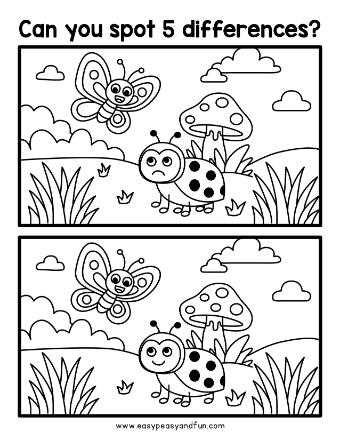
Improve concentration and cognitive ability with activities focused on spotting subtle visual errors between images. These exercises engage both attention to detail and quick thinking, pushing your ability to discern slight discrepancies. Ideal for both children and adults, they provide an entertaining and challenging experience while refining sharpness in visual recognition.
Prepare a series of pictures for this activity that contain minor alterations in certain elements. Participants must closely examine each pair of images to identify mismatches. This task strengthens visual memory and critical observation skills while also providing a fun and competitive environment. Whether used for leisure or as a part of educational exercises, these activities enhance visual processing speed and accuracy.
Make sure the images are clear and varied enough to maintain the challenge. Incorporating different themes–like objects, landscapes, or cartoons–keeps the experience fresh and engaging. These activities can easily be adjusted to different difficulty levels by altering the number or nature of changes. The key is to make each set enjoyable and rewarding to solve, encouraging repeat engagement and improvement over time.
HTML
Practical Guide for Creating Engaging Puzzles
Begin with clear, distinct imagery. Select two pictures with similar elements but subtle modifications. Focus on areas with small alterations, such as color shifts or object movements. This encourages participants to look carefully without overwhelming them.
Ensure the changes are not too abstract. Keep them relevant to the theme of the puzzle. If the context is a nature scene, for example, alterations like missing leaves or changed rock formations are easier for players to identify than abstract shapes or colors.
Vary the size and placement of the changes. Some can be tiny, while others might involve larger components of the image. This balance adds complexity to the puzzle, making it more engaging for participants of varying skill levels.
Test your creations before releasing them. Ask others to solve the puzzle and gather feedback. Adjust difficulty by modifying the number of alterations or their subtlety, ensuring that the puzzle isn’t too simple or frustratingly complex.
Incorporate themes or scenarios. Puzzles involving scenes from popular culture or nature are more appealing. Users are more likely to engage when the context resonates with them. Themes also provide additional clues, making the puzzle-solving process intuitive for participants.
Use simple, clean design for the images. Avoid excessive clutter, which might make it difficult for solvers to focus on the important details. The clearer the pictures are, the easier it will be for participants to spot the inconsistencies.
Consider making variations in difficulty. Offering puzzles with more or fewer changes allows people to choose according to their skill levels. Beginners may prefer puzzles with only a few subtle differences, while seasoned players will enjoy the challenge of puzzles with numerous discrepancies.
Finally, create a satisfying solution path. Ensure that the alterations are solvable without ambiguity. Once completed, a sense of accomplishment should follow. This keeps participants coming back for more and looking forward to the next challenge.
HTML
How to Create Engaging Printable Find the Difference Puzzles
Start with selecting two images that share a similar theme. This will help set a consistent tone for the puzzle and make it visually cohesive. Ensure the objects or scenes in both images are almost identical, with subtle discrepancies that make the search more engaging.
Focus on details like color variations, changes in shape, or hidden objects. These types of small alterations are ideal, as they increase the challenge for the person solving the puzzle while also offering a sense of achievement once discovered.
Keep the number of modifications balanced. Too many alterations can overwhelm the solver, while too few might make the puzzle too easy. Aim for around 5-10 changes per puzzle for a satisfying challenge.
Consider the difficulty level. Adjust the complexity by varying the size and visibility of the changes. Larger differences are easier to spot, while subtle shifts, such as a slight change in hue or the disappearance of a small item, require more concentration and attention to detail.
Incorporate variety in the type of variations you introduce. Instead of only changing the color of objects, try adding or removing small elements like animals, trees, or background patterns. This keeps the puzzle fresh and avoids repetitiveness.
Test the puzzle before finalizing it. Ask others to solve the puzzle to check if the changes are appropriately challenging. Adjust any changes that are too obvious or too obscure based on the feedback.
Make sure the images you choose for your puzzle are clear and high quality. A blurry or poorly lit image makes spotting even the largest changes difficult and frustrating for players.
Lastly, include a solution key at the end, but separate it from the puzzle itself. This allows the solver to check their answers without being tempted to peek too soon, keeping the experience both challenging and rewarding.