
Select a clear Bible translation such as King James Version, New International Version, or English Standard Version, then format the text on A4 or US Letter paper with 1-inch margins and a font size between 14–18 pt for reading distance of 2–3 feet. For framed wall display, increase the title to 28–36 pt and keep line spacing at 1.3–1.5 to avoid crowding.
The Shepherd’s Song from the Book of Psalms contains six verses and approximately 110–120 words depending on translation. This length fits cleanly on a single page without reducing readability. Use serif fonts such as Times New Roman or Garamond for a traditional look, or sans-serif fonts like Calibri for church programs and handouts where clarity under indoor lighting is required.
For home décor, choose 120–160 gsm matte paper to prevent glare under glass frames. For bulletins or memorial cards, standard 80–100 gsm paper works well and folds without cracking. Save the file as a high-resolution PDF at 300 dpi to preserve sharp text edges during printing and scaling.
Printable 23rd Psalm
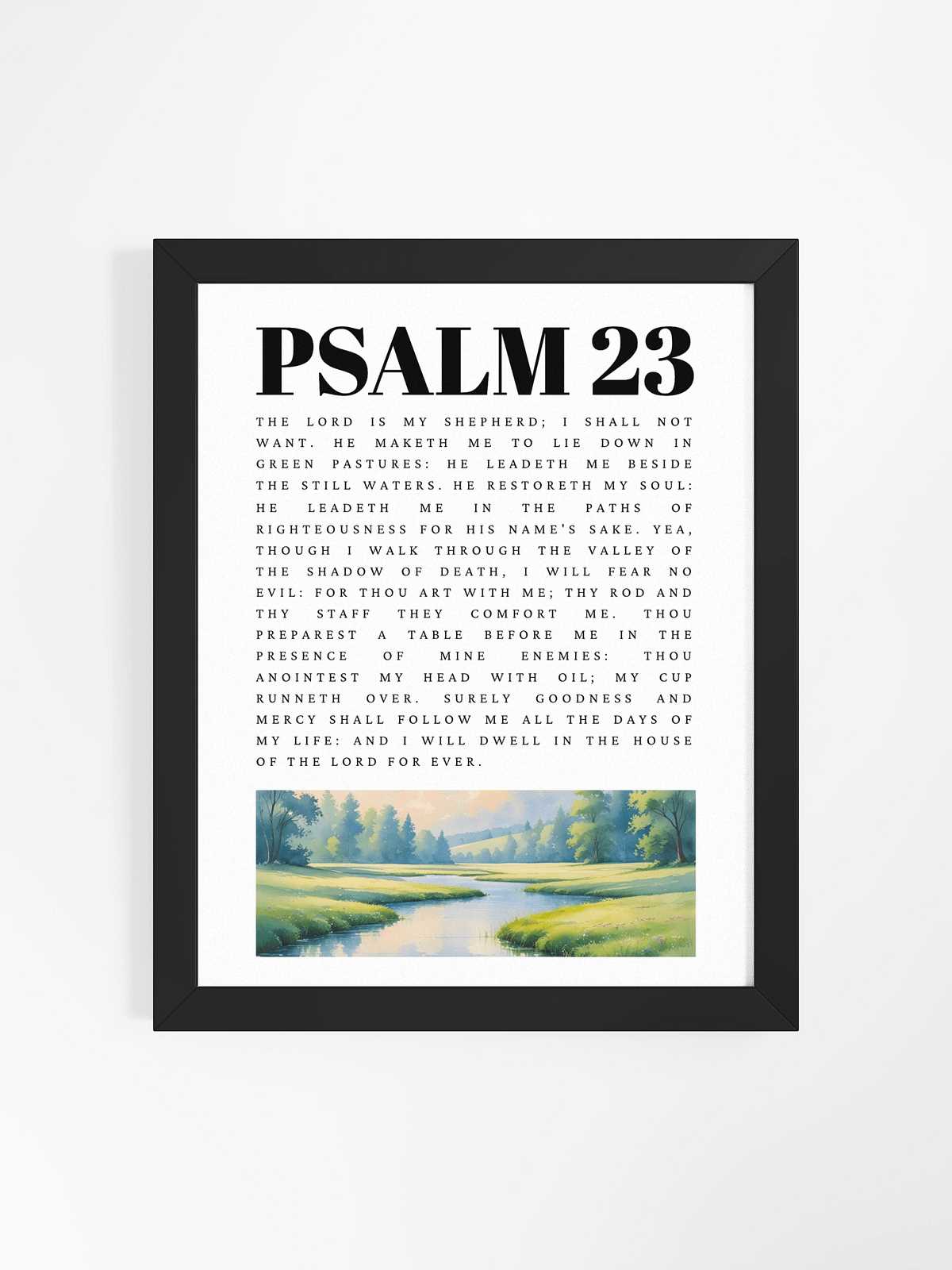
Use a single-page layout with 1-inch margins and 16 pt font size so the Shepherd’s Song remains legible at arm’s length. Six verses fit comfortably on US Letter or A4 without shrinking the text below 14 pt.
Select a trusted Bible version such as KJV, NIV, or ESV and keep the wording intact without decorative line breaks that interrupt sentence flow. Maintain left alignment for reading clarity, and limit decorative initials to the opening line only.
Choose serif fonts like Garamond or Georgia for framed wall display, as their letterforms remain sharp at 300 dpi resolution. For church bulletins or memorial inserts, switch to Arial or Calibri at 12–14 pt to save space while keeping readability under indoor lighting.
Set line spacing between 1.3 and 1.5 to prevent dense blocks of text. Avoid justified alignment, which can create uneven gaps across short poetic lines.
For framed décor, print on 120–160 gsm matte stock to reduce glare behind glass. For handouts, 80–100 gsm paper folds cleanly and feeds smoothly through standard office printers without curling.
Export the file as a high-resolution PDF at 300 dpi and embed fonts to prevent substitution errors during printing. Keep margins consistent to avoid trimming issues if the sheet is later mounted on backing board.
Store a master copy in both PDF and DOCX formats so you can adjust font size, spacing, or page dimensions without retyping the biblical text.
How to Choose the Right Translation of the 23rd Psalm for Printing
Select the Bible version based on the audience and setting where the Shepherd’s Song will be displayed or distributed. Match wording style to reader familiarity and denominational preference before formatting the page.
Use this quick comparison to guide your choice:
- King James Version (KJV) – traditional language, poetic rhythm, widely recognized in funerals and memorial prints.
- New International Version (NIV) – modern vocabulary, smooth sentence flow, suitable for mixed-age congregations.
- English Standard Version (ESV) – formal structure with updated wording, balanced for study and display.
- New King James Version (NKJV) – preserves classic tone with minor language updates.
Check verse length before laying out the page. The KJV text contains approximately 118 words, while NIV and ESV versions may vary slightly in phrasing and line breaks. Shorter lines reduce font compression and allow larger type sizes.
Confirm copyright status prior to distribution. KJV is public domain and can be reproduced without permission. NIV, ESV, and NKJV require proper attribution and may limit commercial use. Include the translation abbreviation beneath the final verse in 9–10 pt font.
Evaluate key wording differences that may affect reader preference:
- “The Lord is my shepherd; I shall not want” (KJV) versus “I lack nothing” (NIV).
- “Valley of the shadow of death” versus “darkest valley.”
- “Surely goodness and mercy shall follow me” versus “shall pursue me.”
For framed wall art, traditional phrasing often aligns with decorative typography. For church programs or classroom materials, modern language reduces reading hesitation, especially for younger audiences.
After selecting the version, lock the wording and proofread against an official Bible source to prevent typographical errors before exporting the final print file.