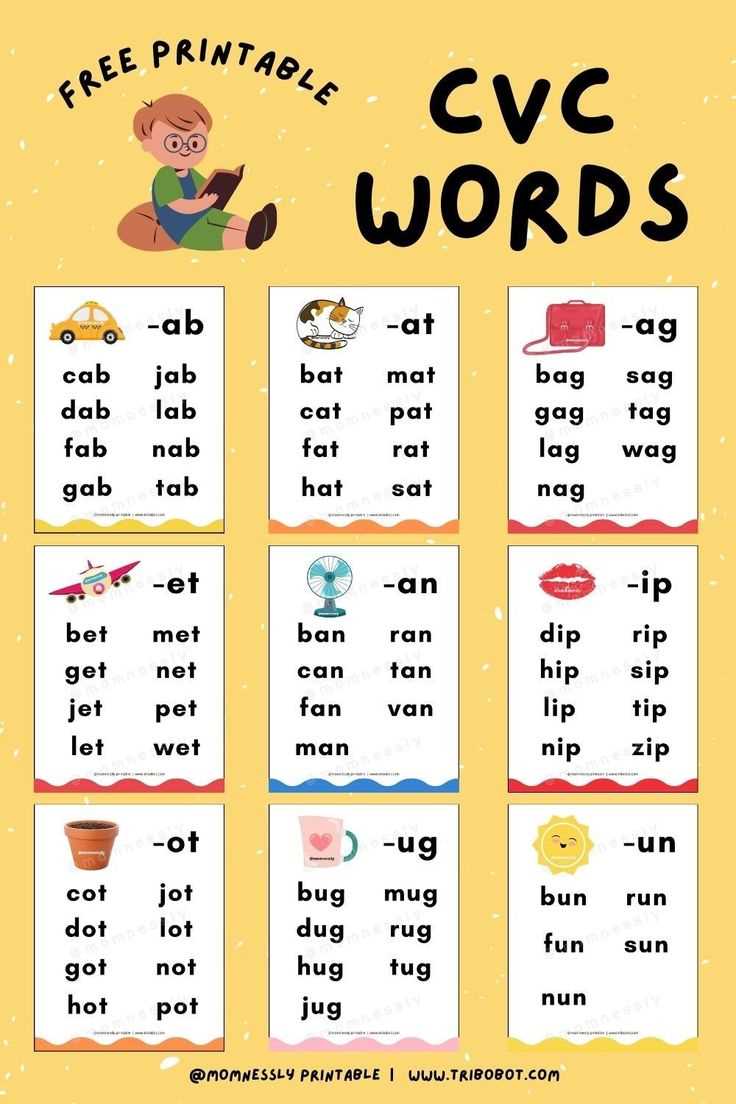
To help children build strong reading skills, focus on simple exercises that emphasize the relationship between consonants, vowels, and consonants. These activities are ideal for early learners as they provide practice in recognizing and reading short, simple words. You can easily adapt these activities to suit the individual learning needs of each child.
One effective method is to use exercises where children match images with corresponding words that follow a basic structure of consonant-vowel-consonant (CVC). For example, pairing a picture of a “cat” with the word “cat” helps children recognize letters and sounds together, improving both their phonics and vocabulary skills.
Additionally, incorporating fun and engaging activities like word building games, where students manipulate letters to form words, helps reinforce their understanding. These types of tasks can easily be customized by adjusting the difficulty level, such as adding more complex words or introducing new letter combinations as children progress in their learning.
How to Use Word Building Exercises for Early Reading Practice
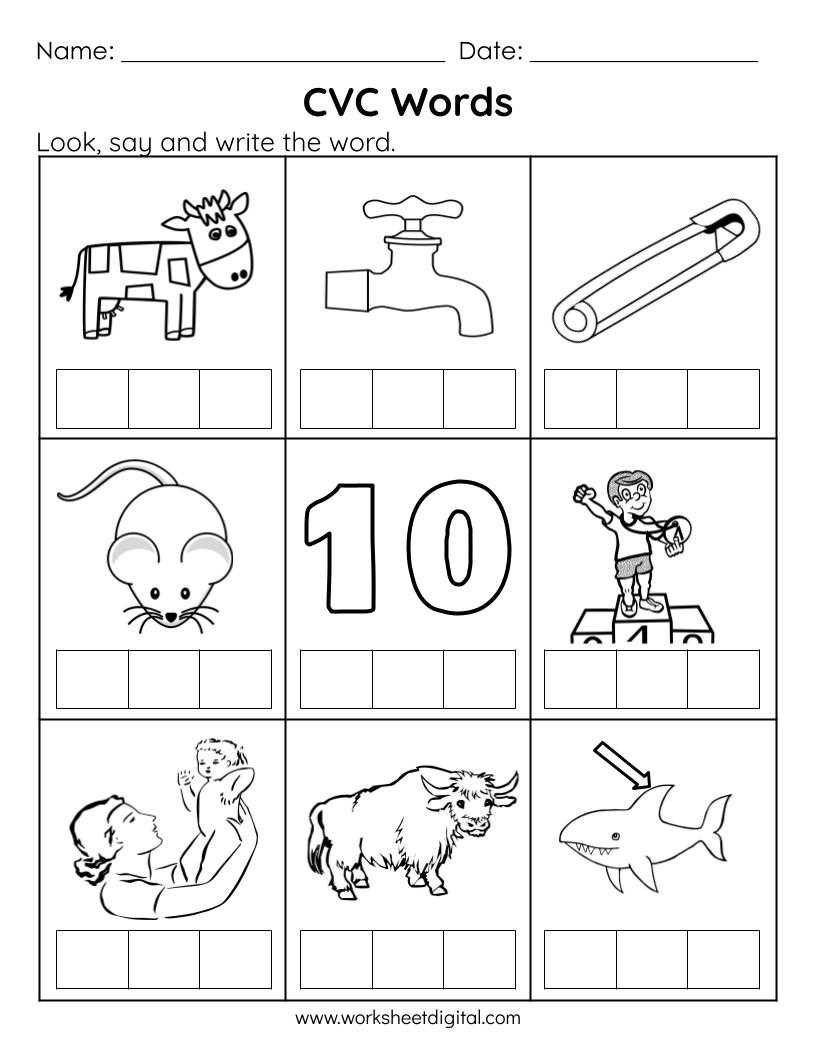
Start by selecting activities that focus on the most common letter patterns and sounds. These tasks are designed to reinforce phonetic skills, allowing young learners to recognize and blend sounds more easily. Begin with simple three-letter words to build confidence, ensuring that each letter’s sound is clear and distinguishable for the child.
Once you’ve selected the right activities, encourage children to practice decoding words by sounding them out. For example, when working with the word “cat,” prompt the child to say each sound separately: /k/ /a/ /t/ before blending them together. This method helps improve their ability to decode unfamiliar words in the future.
As children become more comfortable with basic words, introduce matching exercises where they connect pictures with corresponding words. For instance, pair a picture of a “dog” with the word “dog.” These types of exercises reinforce the connection between spoken and written language, making reading more accessible and enjoyable.
Incorporate word building games where children can rearrange letter tiles or cards to form words. This hands-on activity promotes engagement and strengthens memory retention. You can also add a challenge by introducing new sounds or letter combinations as the child’s abilities grow.
- Start with simple 3-letter words and focus on basic letter sounds.
- Encourage sounding out words to improve decoding skills.
- Use matching exercises to connect pictures with corresponding words.
- Engage children with word-building activities like letter tiles or cards.
Effective Strategies for Teaching Simple Word Patterns
Start with sound segmentation. Encourage children to break down words into individual sounds, such as /k/ /a/ /t/ for the word “cat.” This helps them understand the phonetic structure of words and builds their decoding skills. Begin with easy words and gradually increase the difficulty as their confidence grows.
Introduce blending exercises. After segmenting words, have students blend the sounds together to form the word. This practice is key to improving fluency. For example, after hearing /m/ /a/ /t/, children should be able to say “mat” smoothly, which is essential for early reading success.
Use visual aids like pictures to reinforce the meaning of words. Pair a picture with each word so children can associate the written word with its meaning. This helps bridge the gap between spoken and written language, enhancing comprehension. Activities that involve matching images with words can be highly effective.
Incorporate fun, interactive games to maintain engagement. Use letter tiles or flashcards where children can build their own words. Challenge them to form new words by swapping letters, such as turning “mat” into “hat.” These games make learning enjoyable while reinforcing spelling and word recognition skills.
Encourage repetition through tracing. Have children trace the words multiple times to strengthen their writing skills while reinforcing the word’s structure. This also helps with letter formation and promotes muscle memory for word recognition. Repetition is key in reinforcing these foundational skills.
- Start with sound segmentation and blending exercises.
- Use pictures to associate words with their meanings.
- Engage students with interactive games like letter tiles or flashcards.
- Incorporate tracing activities to improve writing and word recognition.