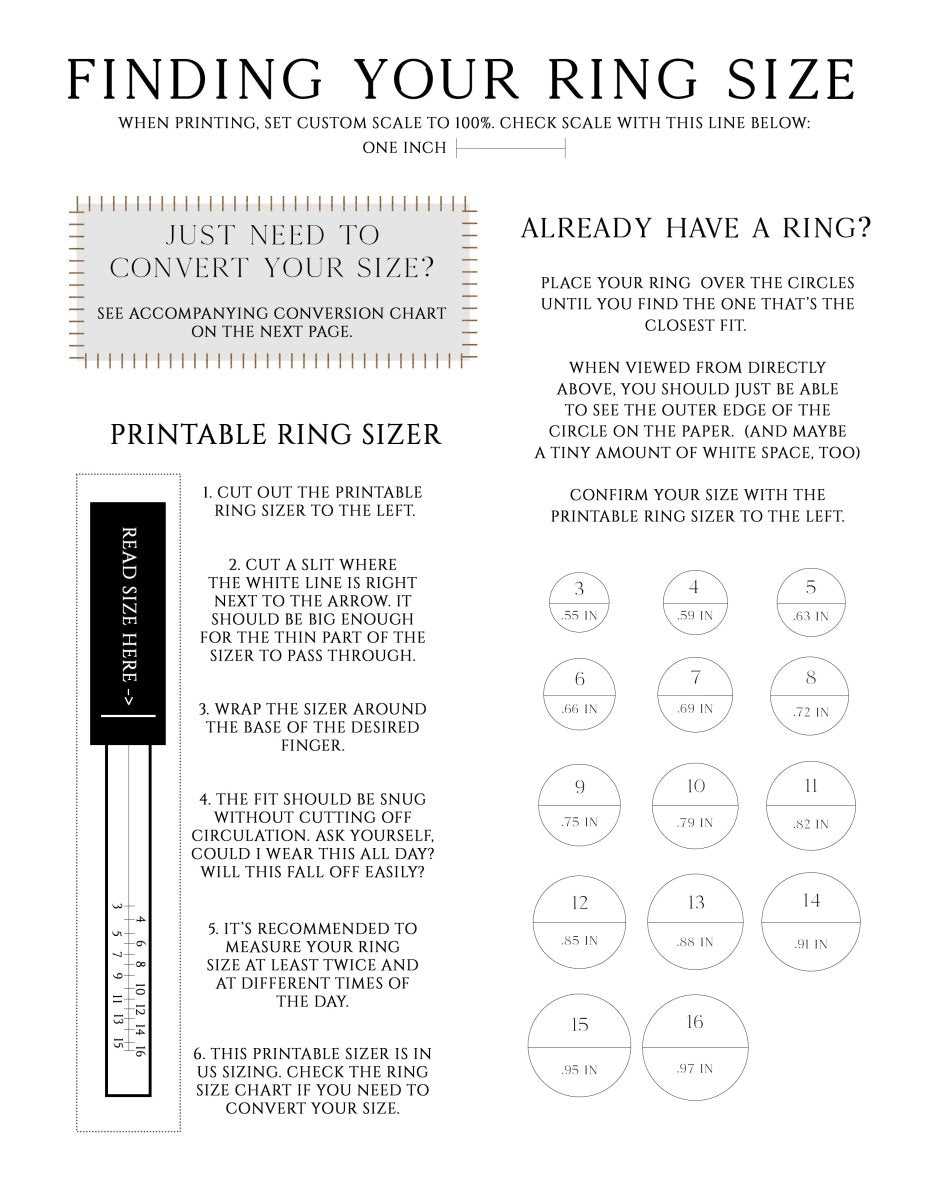
To ensure a perfect fit, use a guide that clearly marks your finger’s circumference with precise measurements. A simple and effective method is to measure around the base of your finger with a string or paper strip, then compare it to the corresponding values listed on a sizing guide.
It’s important to measure at the end of the day when your fingers are naturally at their largest. Avoid measuring your finger when it’s too cold, as it can cause the finger to shrink slightly, leading to inaccurate results.
Once you have your measurement, double-check it with the table, making sure to match the length of the string or paper to the units indicated. If your measurement falls between two values, consider the fit preference–whether you want a snug or slightly looser feel–and select the closer match.
Ring Size Printable Guide for Quick Measurement
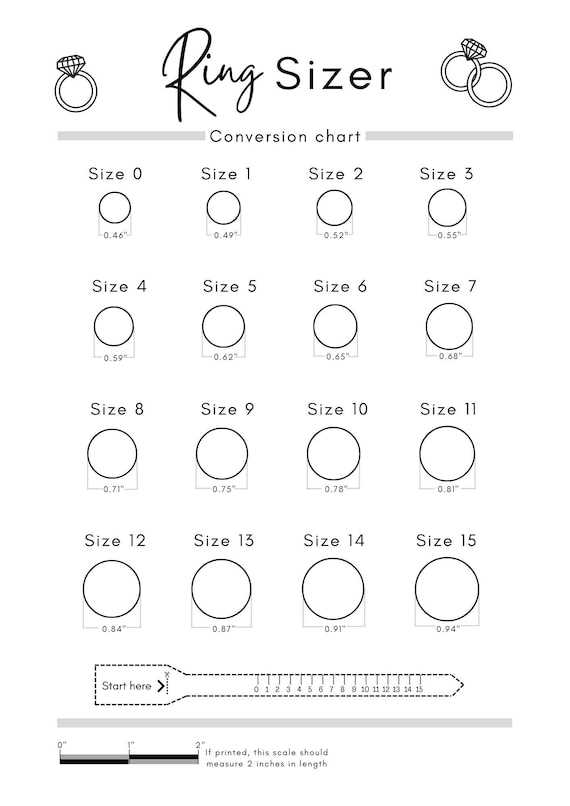
To find the right fit, print out a sizing guide at home. Make sure to select the version that includes real measurements, with a scale that reflects accurate dimensions in millimeters or inches. This will help you quickly compare your finger’s circumference with the provided guide for an accurate match.
If you don’t have access to a printer, use a paper strip or string. Wrap it around your finger, mark where the ends meet, then measure the length with a ruler. Compare this measurement with the sizing guide to find the closest match. Avoid stretching the paper or string to ensure a precise reading.
Ensure your measurement is taken at room temperature when your finger isn’t swollen or too cold. The time of day can affect your finger’s width, so it’s best to measure in the evening when your fingers are at their natural size.
Many guides offer a simple line-to-line comparison, where you match your finger’s length to the nearest value. However, some also feature a circular template that you can cut out and place over your finger to see if it fits within the designated spaces. This provides a more hands-on, immediate way to check for a good fit.
Don’t rely solely on online guides without checking them against your real measurement. Use a standard guide that includes a detailed scale to verify its accuracy. When in doubt, try multiple methods, such as using a paper ruler or checking with a local jeweler for confirmation.
For larger or smaller fingers, you may find some sizing guides are less accurate. In these cases, consider using a flexible material like a fabric tape measure, which conforms to your finger shape and provides a more reliable result.
For a precise fit, check multiple guides if needed. Adjust for comfort: if your finger feels tight when wearing a band, move to the next available size. A good fit should allow you to slide the band on and off with a little resistance, without feeling uncomfortable.
How to Accurately Measure Your Finger at Home
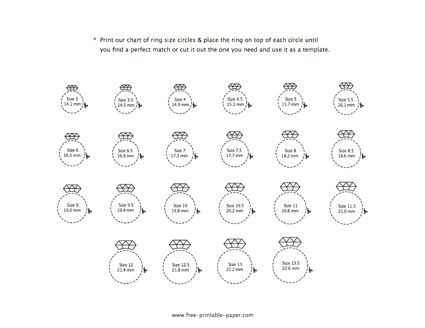
Begin by using a string or a strip of paper to wrap around the base of your finger. Make sure the material sits snugly but not too tightly. Once it’s in place, mark the point where the ends meet.
Next, use a ruler to measure the length of the string or paper strip in millimeters. This measurement represents the circumference of your finger, which you can then compare with a sizing guide for an accurate match.
For better accuracy, use a flexible tape measure if available. This will allow you to follow the natural curve of your finger and achieve a more precise measurement compared to a straight-edged ruler.
Take the measurement at the end of the day, when your finger is at its largest. Avoid measuring your finger in the morning or after physical activity, as these factors can cause your finger to swell or shrink.
If your measurement falls between two values on the sizing guide, choose the larger option. A slightly looser fit can be more comfortable for everyday wear.
Once you’ve measured, check the fit with an actual band. Slide it over your finger to ensure it fits comfortably. If it feels tight or too loose, adjust your measurement accordingly and try again.