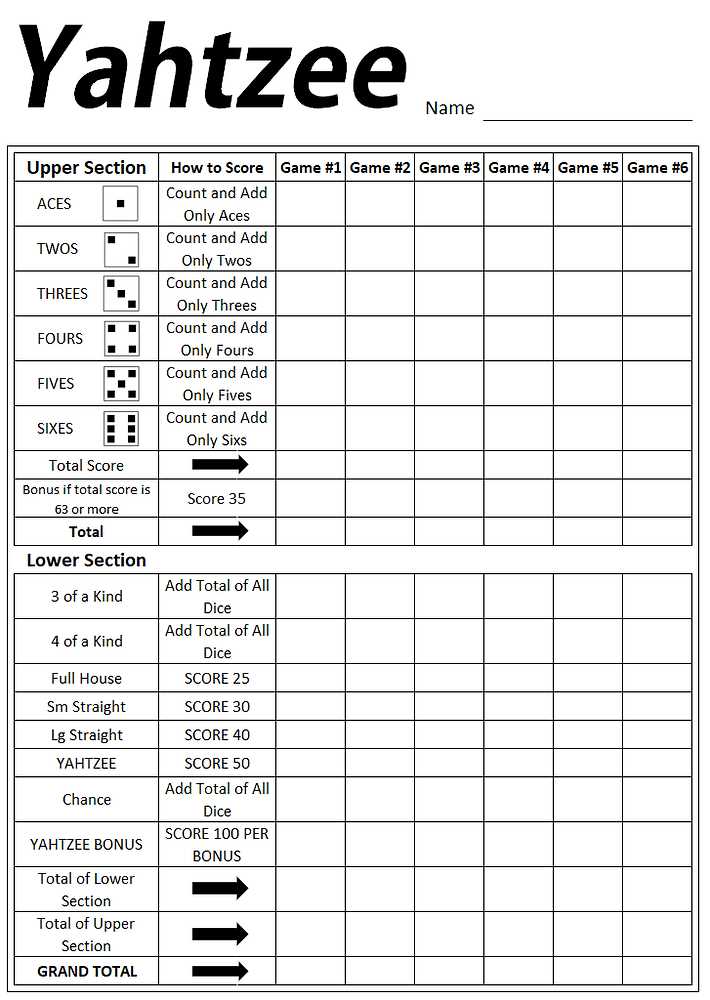
Download a clean A4 or US Letter game sheet with clearly separated upper and lower sections and a 35-point bonus field for totals above 63. Choose a layout with large writing cells (at least 12–14 pt text height) so results remain readable during fast rounds with five dice and up to 13 scoring lines per player.
A standard tally form includes number-based combinations (ones through sixes), three and four of a kind, full house (fixed 25 points), small straight (30), large straight (40), five-of-a-kind (50), and a free-choice line. Check that the template provides columns for multiple participants and separate subtotal, bonus, and grand total rows to avoid manual recalculation.
For home printing, select black-and-white PDF files with thin 0.5–0.75 pt table borders to reduce ink use. Keep margins at 10–15 mm so no fields are cut off. If you host frequent sessions, place 2–4 sheets on one page and trim them with a paper cutter to save paper and store compact stacks for future games.
Yahtzee Score Card Printable
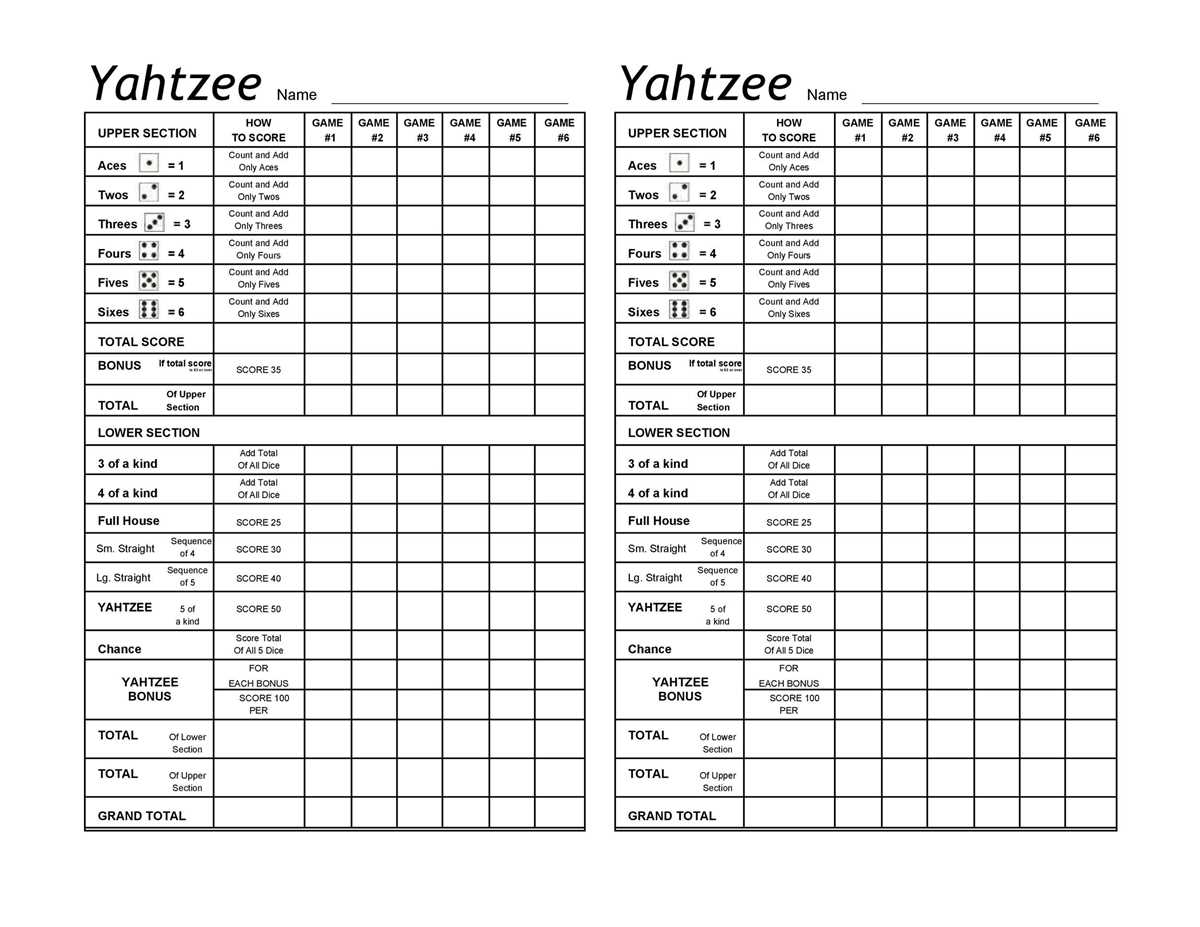
Use a one-page tally sheet with all 13 combinations arranged in two blocks and a clearly marked 35-point bonus row for totals above 63. Select a layout where each entry cell is at least 1.2 cm high so players can record results quickly during three-roll turns with five dice.
Include separate columns for up to six participants to avoid mixing results. A well-structured template places number-based lines (ones through sixes) at the top, followed by three of a kind, four of a kind, full house fixed at 25, small straight at 30, large straight at 40, five-of-a-kind at 50, and a free-choice line for any combination.
Choose a PDF file formatted for US Letter (8.5×11 inches) or A4 (210×297 mm) with margins no smaller than 10 mm. This prevents clipped borders and keeps subtotal, bonus, and grand total fields visible after trimming.
For repeated sessions, arrange two or four reduced sheets per page. Set scaling to 90–100% and disable “fit to page” if it distorts table proportions. Thin grid lines between 0.5 and 0.75 pt reduce ink consumption while keeping columns readable.
Keep upper and lower section subtotals separated by bold horizontal rules. This visual break limits arithmetic mistakes when adding number-based points and checking eligibility for the 35-point bonus threshold.
Store unused forms in labeled folders by paper size and player capacity. Preparing stacks of 20–30 sheets saves setup time during tournaments or classroom activities.
If you track statistics across multiple rounds, add a small date field and match identifier at the top of each page. This allows later comparison of high totals, frequency of straights, and distribution of five-of-a-kind results without rewriting data.
Standard Scoring Categories and Bonus Rules Explained on the Score Card
Fill the upper section with the sum of matching dice faces and track the subtotal carefully; reaching 63 points here grants a fixed 35-point bonus added before the final total is calculated.
- Ones through sixes: add only dice showing the selected number.
- Example: three 4s equal 12 points in the “Fours” line.
- Maximum upper-section subtotal without bonus is 105.
Record three of a kind and four of a kind as the sum of all five dice, not just the matching set. If the combination is not met, enter zero; leaving blanks leads to miscounts later.
- Full house: any three-of-a-kind plus a pair, fixed 25 points.
- Small straight: four sequential values (e.g., 2-3-4-5), fixed 30 points.
- Large straight: five sequential values, fixed 40 points.
- Five-of-a-kind: all dice identical, fixed 50 points.
- Chance: total of all dice, no pattern required.
Mark zero immediately in any unused line once all three rolls are completed and no valid combination fits. Delaying this decision creates confusion in later rounds.
Apply the 35-point bonus only once and only if the upper subtotal reaches or exceeds 63. Write the subtotal clearly, then add 35 in the designated bonus row before transferring the amount to the grand total field.
Keep lower-section fixed values separate from sum-based entries. Mixing fixed awards like 25 or 40 with calculated totals without visual separation increases arithmetic errors.
After all 13 lines are filled, add upper subtotal, bonus (if earned), and lower section total to produce the final result. Double-check additions column by column rather than calculating everything in a single step.