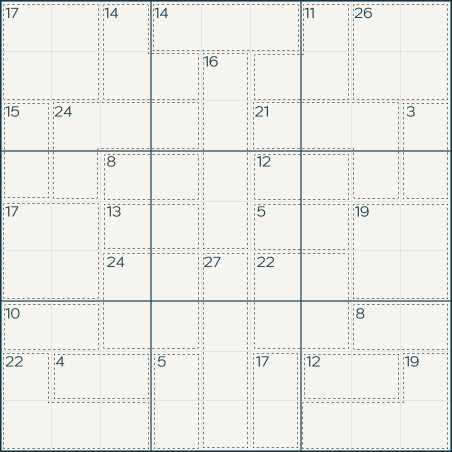
If you enjoy challenging puzzles, this activity is perfect for you. Begin by reviewing the rules for number placement and sum requirements in each cage. Understanding these fundamentals will streamline your approach and make it easier to solve the most complex grids.
Start by picking grids that match your skill level. If you’re just getting started, try medium-difficulty puzzles and work your way up to the advanced ones. Each puzzle provides a new challenge and an opportunity to sharpen your logical reasoning skills.
For quick access, download and print out several different designs so you can jump right into solving whenever the mood strikes. Many websites offer free downloads, making it simple to get started. Make sure you have a pen or pencil ready to mark your answers and take note of the cages as you work through the puzzle.
Printable Killer Sudoku
When tackling a grid puzzle, begin by reviewing the sum requirements in each cage. These sums are crucial for solving the puzzle, as each cage must match the target sum without repeating numbers. Understanding how to break down the problem into smaller sections makes solving easier.
Next, check the grid for obvious placements. Start by filling in numbers in the cages that have few options or a clear solution. For example, if a cage has a sum of 3 with only two cells, the only valid combination is 1 and 2. These easy wins can help you build momentum for more challenging sections.
Pay attention to the number placement restrictions. Each row and column must have unique digits, just like in a traditional puzzle. This rule will prevent you from repeating numbers within a row or column, ensuring accuracy as you fill in the grid.
If you are working on a more difficult puzzle, consider breaking down larger cages into smaller subgroups. Try to identify numbers that can only fit in certain spots within the cage, and use this information to eliminate other possibilities. Sometimes, taking a step back to reevaluate the grid can reveal hidden patterns.
Some puzzles will require multiple steps of deduction, so it’s important to stay organized. Use a pencil to write down possible numbers in cells where you’re unsure. These “candidate” numbers will help you track potential solutions without making permanent mistakes.
If you find yourself stuck, don’t be afraid to use a process of elimination. Start by eliminating impossible numbers for certain cells, then narrow down the possibilities. Over time, this method will guide you towards the solution, even when the puzzle seems difficult.
Once you’ve completed the grid, check your work by verifying that each cage sum matches its target and that no numbers repeat in the rows or columns. The satisfaction of solving the puzzle comes from both accuracy and creativity in problem-solving.
For easy access to a variety of difficulty levels, look for downloadable grids. Many websites offer free resources that allow you to print multiple designs. Whether you’re a beginner or an expert, these puzzles provide a fun way to improve logical thinking and enjoy a rewarding challenge.
How to Solve Killer Sudoku Puzzles Step by Step
Begin by scanning the grid for smaller cages that have limited options. These are often the easiest to solve and will provide a strong foundation for progressing through the puzzle. For example, a cage with two cells that needs to sum to 3 can only have the numbers 1 and 2 in either order. Fill these in first to open up more possibilities.
Next, examine each row and column for missing numbers. In traditional puzzles, each row and column must contain all digits without repetition. Use this rule to eliminate possibilities within the smaller cages. For instance, if a certain number is already present in a row, it cannot appear in a corresponding cell within that row’s cage.
Look at the sum requirements of each cage and start eliminating invalid possibilities. For cages with more than two cells, identify the range of numbers that can fit within the cage. For example, if a cage with three cells requires a sum of 15, it cannot include the numbers 1, 2, or 3, as their sum would be too small. Narrowing down the possibilities helps eliminate options and reduces the complexity of the puzzle.
If you’re stuck, use a process of elimination. Check for cells where only one number can fit. These are typically revealed by intersecting rows, columns, and cages with similar constraints. Mark these numbers and continue filling out the grid incrementally, using logic and the rules of the puzzle to guide you.
As the puzzle progresses, remember to constantly check for consistency. After every step, revisit previous cages and check for new deductions. The more cells you fill in, the more interdependencies between cages, rows, and columns will become apparent. This step-by-step checking ensures accuracy and prevents mistakes.
Finally, when the puzzle is complete, verify that every row, column, and cage adds up correctly and contains unique numbers. Ensuring the correctness of all sums and placements is vital to confirming that the puzzle is solved correctly. With practice, this method will become faster and more intuitive, enhancing your puzzle-solving skills.