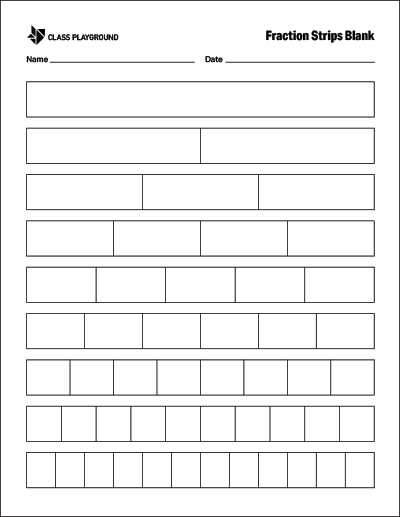
To help students grasp the concept of fractions, consider using visual tools that break down each part clearly. These aids are ideal for making abstract concepts tangible and easier to understand. By presenting numbers in a visual way, students can better comprehend how parts relate to a whole.
Start by printing out templates that represent various portions of a whole. Each section should be distinct, allowing learners to easily compare different values. This method helps in building a stronger foundational understanding, especially for younger students or beginners.
Once printed, cut out the segments and organize them according to size. You can use these sections to demonstrate addition, subtraction, or equivalency between different amounts. Mixing and matching the parts also provides an engaging hands-on experience that reinforces what students are learning.
Using Visual Aids for Understanding Parts of a Whole
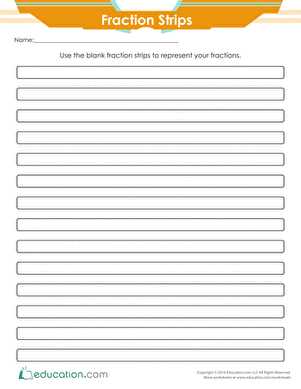
Begin by organizing each piece to reflect different parts of a whole. This can help learners easily identify relationships between various portions. The visual layout will allow them to understand the relative sizes of each section compared to the whole object.
Print out templates with varying proportions, ranging from halves to eighths, to give students a clear view of different parts. Ensure that each part is labeled appropriately, making it easier to see the exact size of each segment. These templates should also have clear lines and be simple to cut out to avoid confusion when manipulating them.
Once printed, cut the pieces accurately to avoid any distortion in the fractions. This will help in exercises where students must align or compare parts to determine their equivalent sizes. Neatly cut pieces are also helpful in maintaining consistency during learning activities.
Use these cut pieces for visual exercises. For example, have students match two parts to form a complete object, helping them visualize addition or subtraction of fractions. This hands-on approach makes learning more interactive and allows students to physically manipulate the portions, making the concept more tangible.
These templates also work well for teaching equivalency. For instance, you can show how two 1/2 pieces are the same as one whole. Similarly, demonstrating 1/3 and 2/6 as equivalent parts can deepen the student’s understanding of how different parts can represent the same value.
For more advanced lessons, use these segments to introduce mixed numbers or improper fractions. Students can practice converting between these formats by combining or dividing the segments as needed. This step helps develop a deeper understanding of fraction manipulation.
By using a variety of examples, students can experiment with comparing different portions. For instance, a 1/2 piece can be placed next to a 1/4 to visually show how one part is larger than the other. These visual cues allow learners to draw direct comparisons and make abstract concepts easier to grasp.
Lastly, these tools can be used in collaborative activities. Students can work in groups to solve problems involving combinations of fractions, enhancing their teamwork and problem-solving skills while reinforcing their understanding of mathematical concepts.
How to Use Visual Tools for Teaching Math Concepts
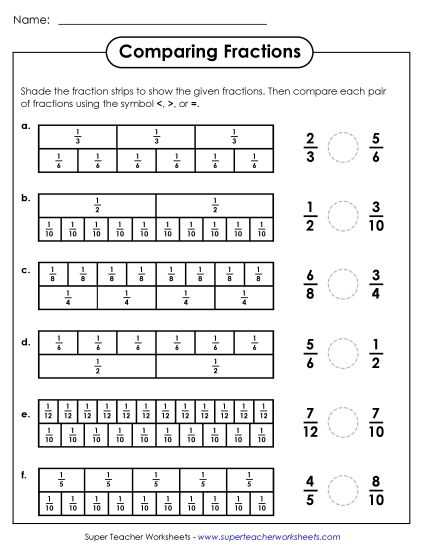
To teach math concepts like parts of a whole, start by providing students with different portions and have them compare their sizes. Use these pieces for simple addition and subtraction exercises, where students physically combine or separate them. For example, ask students to combine two halves to make a whole or to break a whole into smaller parts. This hands-on approach reinforces the understanding of how different sections relate to a complete unit.
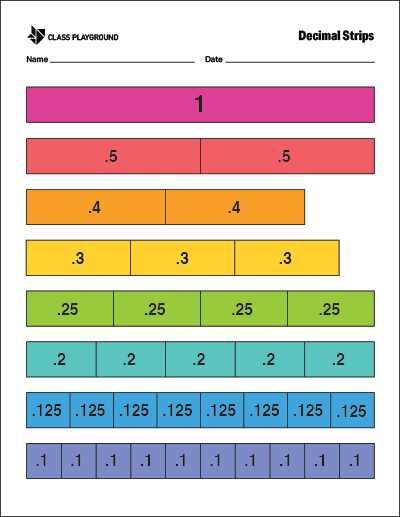
These tools can also be used to explore equivalency. Show students that two 1/4 sections are the same as one 1/2 section. Use the segments to visually demonstrate how to simplify fractions, compare values, and convert between different formats. This method helps students gain confidence in manipulating numbers and understanding the relationships between parts and wholes.