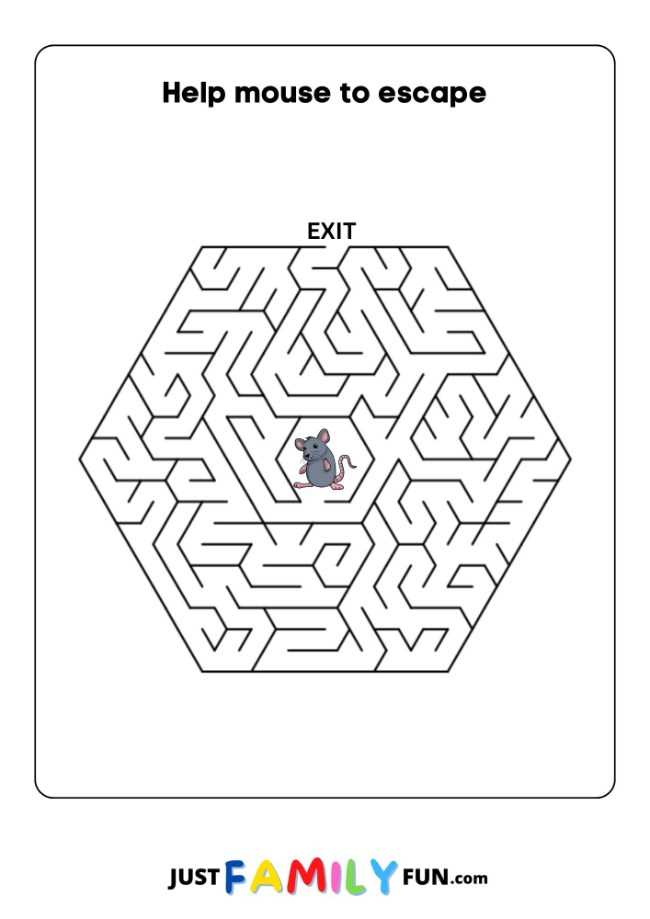
Choose path-finding worksheets with bold 6–8 mm wide lines and large start/finish icons to match the motor skills of children aged 3–5. Pages formatted in A4 or US Letter with high-contrast black outlines reduce visual strain and allow clean home printing at 100% scale without distortion. For beginners, select single-path designs that require no backtracking and limit the number of turns to fewer than ten.
Use themed sheets–animals, vehicles, food, seasons–to connect routing tasks with vocabulary practice. For example, a page where a child guides a kitten to a ball supports both directional language (“left,” “right,” “around”) and fine motor control. Keep backgrounds uncluttered; avoid shaded fills and thin gray lines that fade on inkjet printers.
Organize materials by difficulty: Level 1 with straight corridors and wide spacing, Level 2 with gentle curves and simple dead ends, Level 3 with branching choices and tighter pathways. Mark each page with a small difficulty icon in a corner so adults can quickly assemble a 10–15 minute practice set without flipping through every sheet.
Print on 120–160 gsm paper to prevent marker bleed-through, and offer both color and outline-only versions. Outline-only files save ink and allow children to color the scene after completing the route, extending engagement by 5–7 minutes per page. Store completed sheets in a dated folder to track pencil grip, line control, and error frequency across several weeks.
Rotate tasks weekly and combine them with tracing, dot-to-dot, and simple counting activities to build hand strength and spatial reasoning in short, focused sessions. Limit each sitting to 3–5 pages, encourage slow, continuous strokes, and replace erasing with a fresh copy to keep practice fluid and frustration low.
Preschool Mazes Printable: Age-Appropriate Designs and Printing Guide
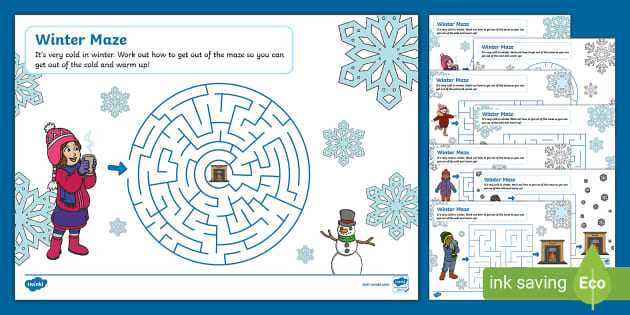
Choose path-finding worksheets with 3–5 wide corridors and no dead ends for children aged 3–4; for ages 4–5, select layouts with 6–10 turns and 1–2 simple false routes. Line thickness should be at least 3 pt to support developing motor control, and corridors should measure no less than 8–10 mm wide to prevent frustration. Use clear visual goals such as animals, vehicles, or fruit placed at the finish point to maintain attention without adding distracting background details.
Match difficulty to developmental markers: children who can trace straight and curved lines without lifting the pencil are ready for multi-turn path sheets; those still mastering grip benefit from short, horizontal routes occupying half a page. Avoid tiny decorative elements; keep contrast high with black lines on white background. For themed sets, group activities by concept–shapes, letters, numbers–so each sheet reinforces one skill instead of mixing multiple tasks on a single page.
Print on A4 or US Letter at 100% scale; disable “fit to page” to preserve corridor width. Use 120–160 gsm paper to reduce tearing and ink bleed. Select grayscale mode to keep lines sharp and prevent smudging from saturated colors. If using home inkjet printers, set quality to “standard” rather than “draft” to maintain clear borders without excessive ink usage. Laminate frequently reused sheets and pair them with dry-erase markers for repeated practice.
Store completed route activities in labeled folders by difficulty level and track completion time to measure progress. Replace sheets once a child completes the same layout in under 30 seconds without crossing boundaries. Rotate themes weekly to maintain engagement while keeping structural complexity consistent.
How to Choose Age-Appropriate Preschool Mazes Printable by Skill Level and Line Complexity
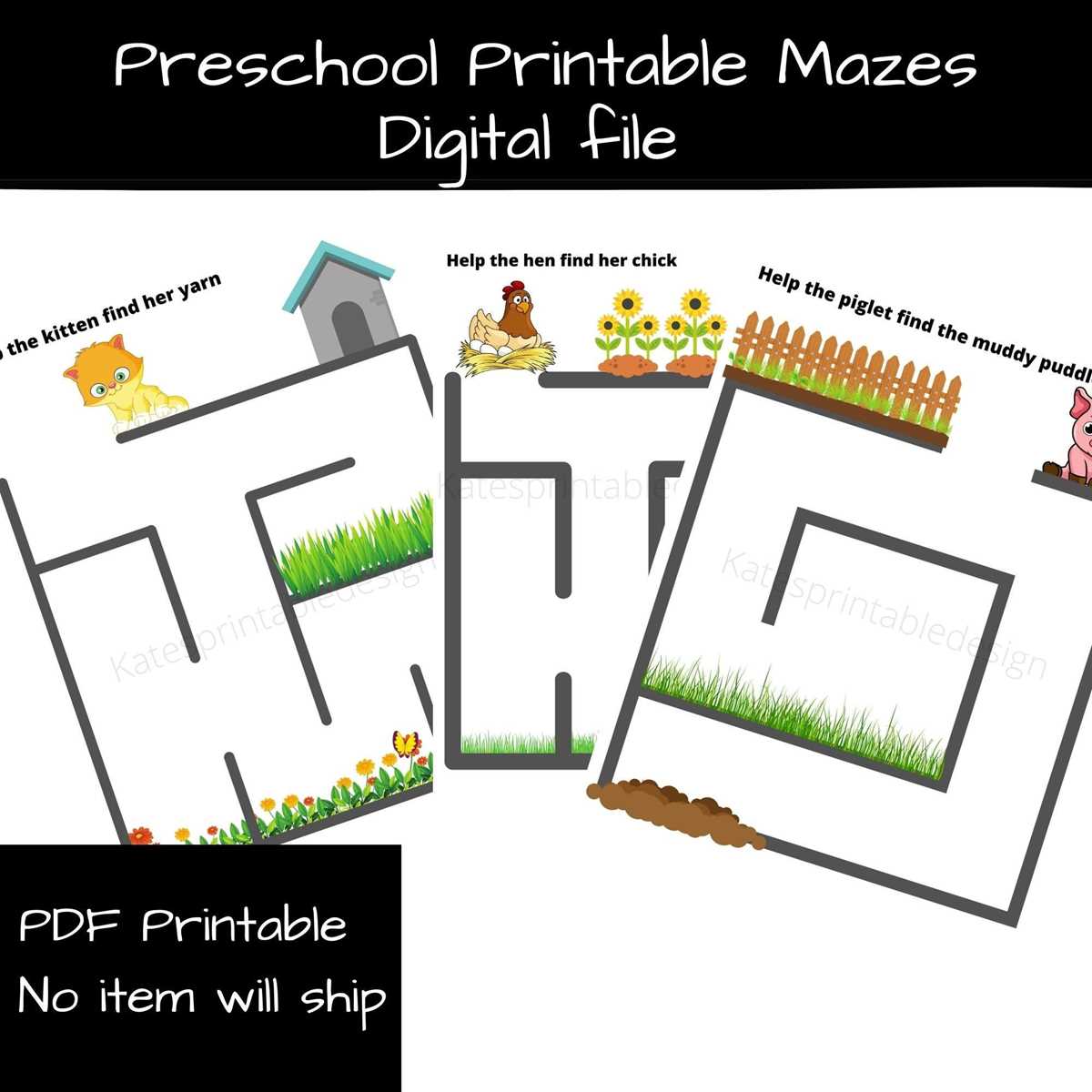
Select activity sheets by matching path width, turn frequency, and visual density to the child’s fine motor control. For ages 3–4, choose single-path puzzles with 3–5 wide corridors (at least 8–10 mm thick), minimal intersections, and no dead ends; the route should fit on one page with large start/finish icons and clear boundaries. For ages 4–5, increase complexity to 6–10 turns, introduce a few short branches, and reduce corridor width to 5–7 mm to train pencil precision. For 5–6, add crossovers, moderate dead ends (no more than 30% of total branches), and mixed line styles (solid and dashed) to build visual tracking and planning. Avoid dense backgrounds, tiny decorative elements, or overlapping graphics that compete with the route.
- Count decision points: 3–4 for beginners, 5–8 for intermediate, 9+ for advanced.
- Check average path length: under 20 cm for early learners; 20–35 cm for older children.
- Limit dead ends: 0–1 for beginners; 2–4 for intermediate; up to 6 for advanced.
- Use clear contrast (dark route on white background) to reduce visual strain.
- Provide progressive sets: three sheets per level to track improvement.
Adjust difficulty gradually across a weekly set: Day 1 with straight corridors and 90° turns only; Day 2 with gentle curves; Day 3 combining curves and right angles; Day 4 adding short misleading branches; Day 5 integrating small obstacles such as simple shapes blocking parts of the corridor. Monitor grip pressure and line tracing accuracy–if the child crosses borders more than twice per page, reduce turn density or widen paths by 1–2 mm. Rotate themes (animals, vehicles, seasonal scenes) without increasing structural complexity to keep attention high while maintaining consistent motor demands.