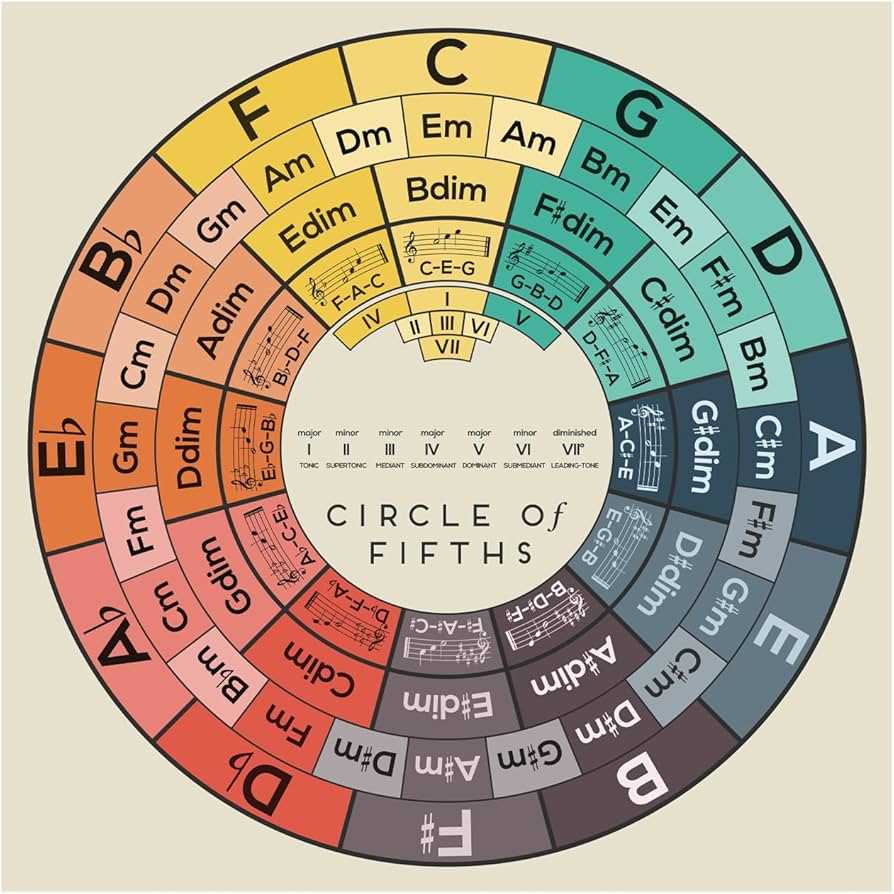
For musicians looking to grasp the connections between different key signatures, a well-structured visual reference can be a powerful tool. With this guide, you can quickly identify the pattern that ties together major and minor keys, facilitating faster mastery of scales and chords.
Understanding how major keys relate to their counterparts, including the number of sharps or flats in each, will help streamline your practice and enhance musical performance. The reference you hold should clearly outline each key’s relationship, making it easy to recall how one scale flows into another based on its relative positions.
When you can spot these relationships in seconds, the process of transposing, improvising, or composing becomes far simpler. It’s not just about memorizing; it’s about creating mental shortcuts that enable intuitive music-making across various genres and styles.
HTML
Understanding the Key Relationships on the Musical Wheel
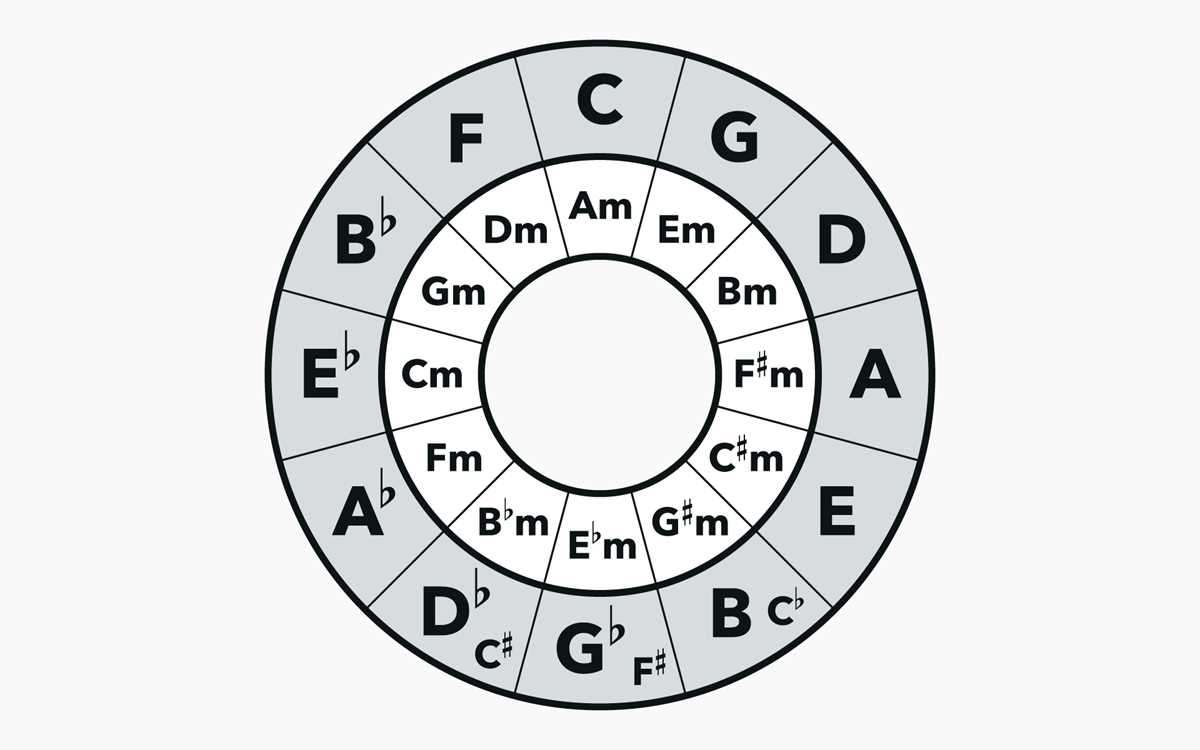
The visual diagram of musical keys is a helpful tool for recognizing how major and minor scales connect. It simplifies the process of shifting between keys, showing the pattern of sharps and flats as they progress clockwise and counterclockwise. This representation aids musicians in making smooth transitions during performances or composition.
One of the best ways to learn key signatures quickly is to use this diagram as a reference. Place it in a visible spot in your practice area, allowing you to easily check for the number of sharps or flats in a specific key. As you practice, you will begin to internalize these relationships and use them naturally in your music.
In the clockwise direction, each subsequent key adds one sharp note. Starting from C major, each key goes up by a fifth, including G major (1 sharp), D major (2 sharps), and so on. Understanding this pattern is essential for grasping the relationships between different tonalities.
The opposite direction (counterclockwise) follows the same principle but with flats. Beginning from C major, each step backward adds one flat note. F major has one flat, B-flat major has two, and this progression continues, helping musicians understand the deeper structure of the key system.
When learning a new key, use this diagram to find related keys. For example, the relative minor of C major is A minor. This is a simple way to explore new tonalities without feeling overwhelmed by unfamiliar notes.
Musicians should also pay attention to the proximity of keys on this diagram. Keys that are adjacent to each other are the most closely related, which makes modulation between them much easier. For instance, C major and G major are adjacent, so transitioning between these two is smooth and feels natural.
This tool is especially useful for composers who are working on key changes in their pieces. By understanding the relationships between keys, you can create more coherent and seamless transitions, giving your composition a polished and sophisticated feel.
Lastly, the diagram can also help with improvisation. By understanding the proximity of keys, musicians can experiment with shifts between related tonalities during solos, adding variety and depth to their performances.
How to Read and Interpret a Harmonic Progression Diagram
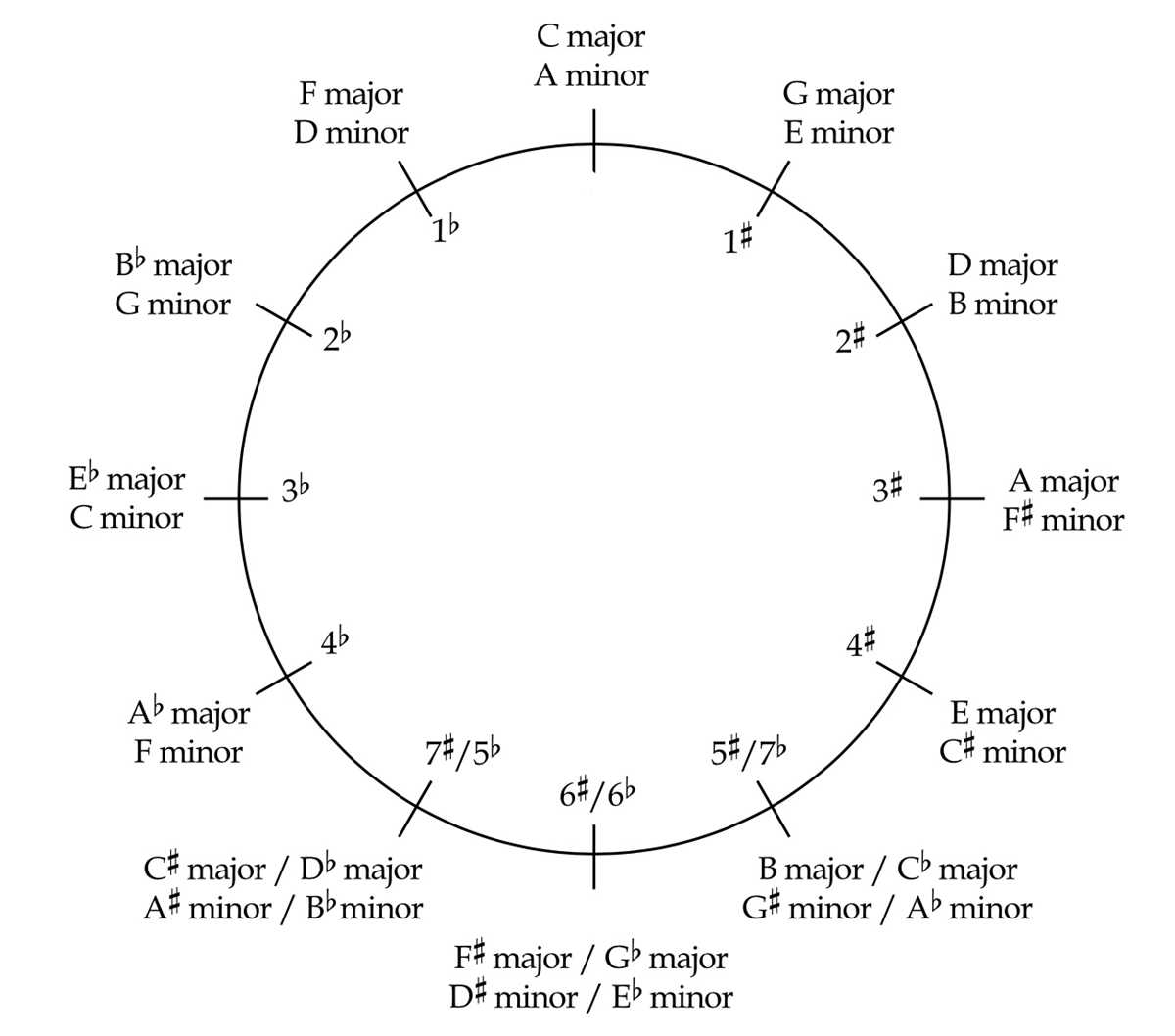
Begin by identifying the key in the center of the diagram. This will often be the tonic or root key, from which all other relationships are derived. Moving clockwise, the keys gradually add sharps, while counterclockwise, they add flats. This gives a visual representation of how keys are connected and how they evolve through the addition or removal of accidentals.
Pay attention to the arrangement of major and minor keys around the diagram. Major keys typically occupy the outer circle, while minor keys are placed inside. This dual structure allows musicians to easily compare related keys and explore their harmonic connections.
Focus on the relationship between adjacent keys. Each one is a perfect fifth away from the previous, which means they share common tones. This relationship is essential for understanding how to transition smoothly between keys during composition or improvisation.
The diagram can also help with chord progression analysis. For instance, the keys positioned next to each other tend to form common harmonic sequences, like a progression from tonic to dominant. Recognizing these patterns will allow you to predict chord movements with greater accuracy.
Lastly, use the positioning of the flats and sharps to understand modulation. Moving clockwise generally indicates modulating to sharper keys, while counterclockwise suggests modulation to flatter keys. This is useful for composers and arrangers when shifting from one key to another without creating dissonance.