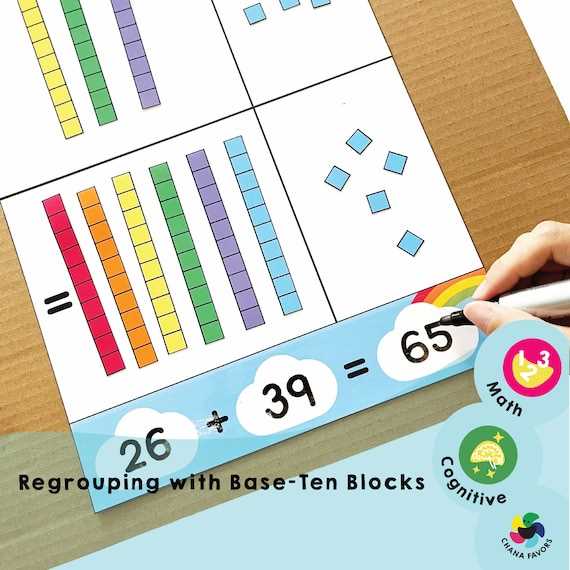
Start by downloading high-quality representations of numbers that break down complex mathematical concepts. These visual tools are perfect for helping students understand place value, addition, and subtraction. Using colored cubes or segmented pieces can give learners a hands-on approach to grasping the value of digits in multi-digit numbers.
For younger children, these objects can be used to demonstrate the concept of grouping and regrouping, offering a tangible way to understand how numbers are built. For example, ten individual units can be arranged into a group of ten, showing the transition from single units to multiples. This visual learning method supports both tactile and visual learners, making it easier to understand abstract math concepts.
Teachers and parents can print these items in various sizes and colors, adjusting the complexity based on the learner’s needs. Whether you’re preparing a lesson plan or a fun home activity, these resources can be easily scaled for different age groups. By printing them yourself, you can ensure the pieces fit the exact needs of your classroom or learning environment.
Using Units for Hands-On Math Practice
To teach the concept of place value and number decomposition, use small, square units that represent individual digits. These simple tools can be arranged in groups to demonstrate larger numbers. For example, a set of ten units can be grouped together to represent a value of ten, while a larger collection can show values like hundreds or thousands. This hands-on method is great for helping students visualize mathematical operations such as addition, subtraction, and multiplication.
Once the numbers are printed and cut out, these objects can be used for a variety of activities. For instance, students can practice addition by physically combining groups of units, making it easier to see how numbers combine. Teachers can also create challenges, such as building specific numbers or solving problems by manipulating the units. This tangible approach makes abstract math concepts more approachable and encourages interactive learning. To get the most out of these materials, make sure to use durable paper or cardstock, ensuring they hold up during frequent use.
How to Use Units for Teaching Place Value
Start by using individual pieces to represent the smallest units, like ones. Then, group ten of these small units together to create a “ten,” and use that as a foundation to introduce the concept of place value. By physically stacking these groups, students can better understand how numbers build on one another from right to left, with each position representing a tenfold increase.
Once the basic idea is understood, expand the lesson by introducing additional groupings, such as hundreds and thousands. For example, group ten “tens” together to make a “hundred,” and ten “hundreds” to form a “thousand.” This helps learners visualize how digits in each position represent different values based on their placement within the number.
For practical exercises, ask students to represent specific numbers by arranging these grouped units. For instance, to represent the number 354, they would use 3 “hundreds,” 5 “tens,” and 4 “ones.” This hands-on method reinforces the concept that the value of a digit depends on its position in the number. To further challenge students, have them add or subtract these groupings to show how place value is affected by mathematical operations.