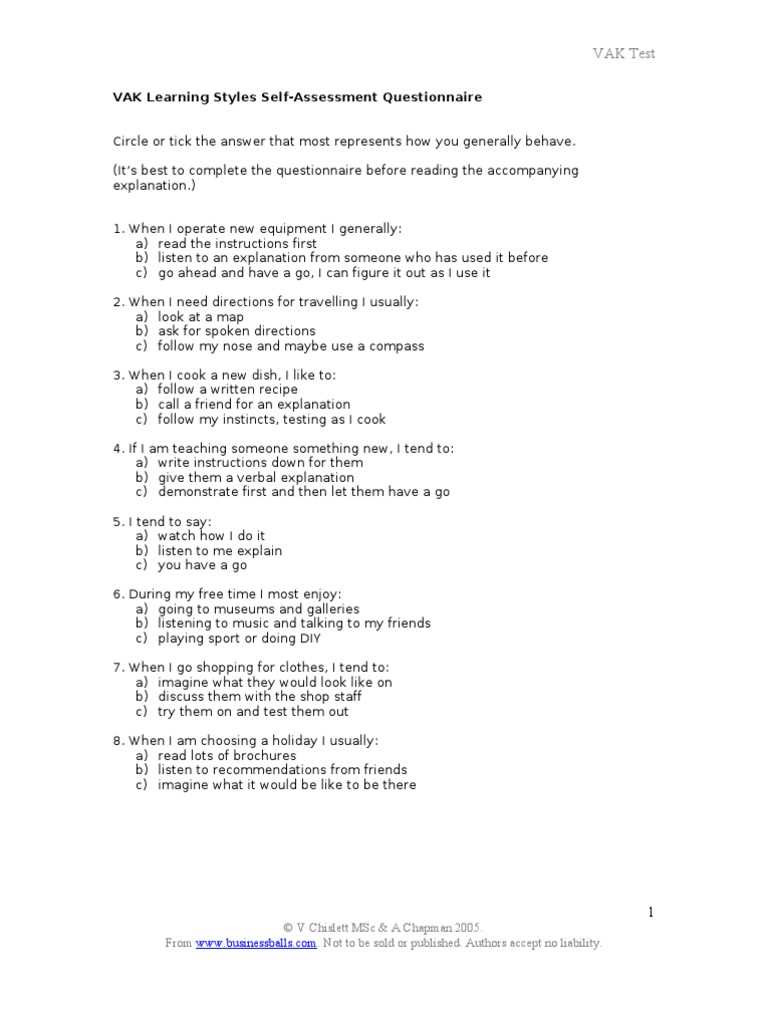
Complete a structured questionnaire to identify whether you absorb information better through visuals, audio explanations, reading, or hands-on practice. Mark each statement honestly based on your usual behavior during classes or independent study sessions.
Score your responses by category to determine which approach dominates. For example, count how many selections relate to diagrams and charts versus discussions or physical activities. The highest total indicates your primary preference, while close scores suggest a mixed approach.
Use the results to adjust study methods by matching techniques to your dominant category. Visual-oriented students can rely on mind maps and color-coded notes, auditory-oriented learners may benefit from recorded summaries, and kinesthetic-oriented individuals should incorporate practical exercises or simulations into their routine.
Reassess periodically to track changes in academic habits or environments. Comparing results over time helps refine strategies and align them with current coursework demands.
Discover Your Learning Preferences with a Detailed Study Style Assessment
Answer each statement based on real study habits rather than ideal behavior. Choose responses that reflect how you usually process information during lectures, reading sessions, or group discussions.
Use a scoring grid divided into categories such as visual, auditory, reading-based, and hands-on approaches. After completing the questionnaire, calculate totals for each column to identify dominant and secondary tendencies.
Interpret results using a clear scale:
- Highest score indicates primary preference
- Second-highest score shows supportive approach
- Close totals suggest a blended method
Match study techniques to your dominant category to improve retention. Visual-oriented students benefit from diagrams and color coding, auditory-oriented individuals retain more through recorded summaries, while hands-on learners gain more from simulations and practical exercises.
Adjust note-taking and revision strategies according to results. Replace long text summaries with charts if visuals score highest, or shift to discussion-based review sessions if verbal processing ranks first.
Repeat the assessment every academic term to track changes in study behavior and refine your approach as coursework and learning environments evolve.
How to Complete a Learning Style Assessment Accurately
Answer based on consistent behavior rather than occasional preferences. Think about how you usually prepare for exams, take notes, and review material, and select responses that reflect repeated patterns.
Complete the questionnaire in one sitting without long pauses. Overthinking answers can distort results, so respond within a few seconds to each statement to capture natural tendencies.
Use a quiet environment with no distractions to avoid random selections. Read each prompt carefully, compare it to real academic situations, and avoid choosing options that sound academically desirable but do not match your habits.
Calculate totals carefully and double-check scoring before interpreting outcomes. Add category scores accurately and verify that no responses were skipped, since missing data can alter the final profile.