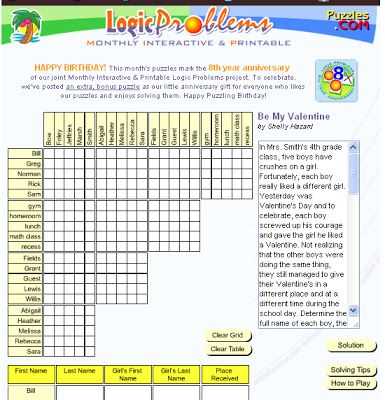
Choose a 4×4 deduction table for beginners and a 5×5 or 6×6 matrix for experienced solvers. A smaller layout limits the number of categories to three or four, reducing cognitive load and making rule tracking manageable. Larger matrices increase combinations exponentially, raising the number of possible pairings from 16 to 36 or more.
Each worksheet should contain clearly separated categories, typically people, items, and attributes such as days or locations. Provide 8–12 concise clues for a 4×4 set and 15–20 for a 5×5 format. Fewer hints create ambiguity; too many remove deductive challenge. Arrange statements in bullet form and avoid compound conditions that mix more than two variables per sentence.
Leave wide margins and use light gray lines for the deduction table to improve readability after printing. A cell size of at least 0.6 inches allows clear marking of X and O symbols. Place instructions above the matrix and include a completed answer key on a separate page to prevent accidental spoilers during classroom distribution.
Printable Logic Puzzles with Grids
Use a 5×5 deduction matrix for mixed-ability groups; it balances challenge and completion time at 20–35 minutes. Limit categories to five and keep each category to five entries to avoid exponential growth in combinations that can exceed 120 possible pairings.
Write 12–18 clues for a medium set and ensure at least three are direct exclusions such as “Anna is not assigned to Tuesday.” Combine negative and conditional statements to guide elimination without revealing the full solution path.
Place category labels on both the top row and left column of the table to reduce eye movement during cross-referencing. A minimum cell width of 15 mm allows clear X and check marks without crowding handwritten notes.
Group clues by type: direct match, exclusion, comparison, and sequence. This structure helps solvers test one variable at a time rather than guessing across multiple attributes.
Keep sentences under 20 words and avoid multi-layer conditions that reference more than two attributes. For example, replace “The person who chose red did not arrive on Monday or sit next to Carla” with two separate statements to maintain clarity.
Provide a separate answer sheet that shows the fully completed matrix rather than a summary list. Seeing the marked table allows learners to review deduction steps and identify where incorrect assumptions occurred.
Adjust difficulty by modifying clue density instead of expanding the matrix size. Removing two indirect hints from a 5×5 set can raise solving time by 30 percent while keeping layout unchanged.
Test each worksheet by solving it without notes or prior memory; if completion requires guessing, revise the hint set. Every conclusion must be reachable through elimination and comparison alone.
How to Read Clues and Fill a Logic Grid Step by Step
Mark all direct matches first; if a clue states “Daniel chose green,” place a check at the intersection of Daniel and green, then cross out every other color in Daniel’s row and every other name in the green column. This single action can eliminate up to eight cells in a 4×4 matrix.
Process negative statements immediately after reading them. For a line such as “The red item was not bought on Friday,” place X marks at each red–Friday intersection across relevant tables to prevent accidental assumptions later.
Handle comparison clues by converting them into positional limits. If one person arrived earlier than another, restrict the later time slots for the first and the earlier slots for the second. Update all related tables to keep consistency across categories.
Break compound hints into atomic parts. A sentence combining two conditions should be split and applied separately to reduce tracking errors and missed exclusions.
After each confirmed placement, scan the entire matrix for rows or columns that now contain only one empty cell; fill that cell immediately and propagate new eliminations. This cascading method prevents reliance on guesswork.
Review the table once all cells are filled by checking every clue against the completed chart. If any statement does not align perfectly, retrace the last confirmed deduction rather than erasing multiple steps at once.